Interaction By Design
Cells in a human body are not simple, static and unconscious building blocks like the bricks in a wall. Cells are live, they can detect what's going on around them, and they can respond in real time to cues from their neighbors and environment. The human body is a society of cells that interact with each other, giving the shape to the structure of the human body. For instance, the brain consists of nerve cells which are connected to each other by synapses. The cell upstream talks to the downstream neuron thru these synapses by sending messages (as neurotransmitters). Only cells which have synapses which have complementary receptors will interact. This link, gives in detail how this human coordination system works. .
Unlike the present day Artificial neural network systems, which is connected together in a unaltering computational forward network. Human systems (both the cells and the neuron network) is a shape changing network of active nodes that interact with each other. The shape of this network reflects the environment in which this human body is immersed in. The fact that the biological cell network works on interactions rather than Computation is the big differentiating factor that gives it the agility and smartness.
Some examples below accentuate this point that "Interaction" will make our systems smart.
- Smart enterprise
An smart enterprise is not a data processing enterprise, but is an enterprise that can respond in real time to the needs in the environment, customers and suppliers. This is achieved by wiring the enterprise like a human nervous system. These wirings are pathways, on which, the right people, devices, other organizations, etc interact with each other, to deliver superior experiences. Such Enterprises, exhibit smart behavior as they can adapt these pathways in real time. Monitoring agents, monitoring key KPIs at runtime and alter this wiring/pathway so the enterprise homeostasis is maintained.
- Smart Digital Supply Network
- Unlike the present day supply chain which is linear, Digital supply network views supply chain as a network of supply chain partners who come together to supply goods by interacting with each other as specified by a contract. This contract is a interaction pathway (the product flow pathway in picture) which specifies the different touchpoints where they interact in the product movement from producer to consumer.

In the picture, the supply network, distributor, spawns a forward product flow pathway which gives all the possible combination of potential interactions. The different interactions, in the forward product flow pathway, moves the product from production to distributor.
For example, thru the interaction Shipment(no 3 in the forward product pathway), the producer, tells the supply chain that goods have been dispatched. The forward product pathway, which resides in the supply network brain, will raise product traceability interaction(no 4 in the forward product pathway) giving link to product manufacturing history at producer.
This dynamic nature of the Digital Supply network, will better margins, better product traceability, fulfillment and supply network response. - Concurrent Computation
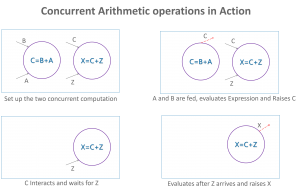
- This picture gives an example of how two computations which are running concurrently interact with each other to produce the final result. The two computations C=A+B and X=C+Z are running in parallel. The right hand side of the arithmetic operation is the sink and the left hand side is the source. When sink and source are present, they interact. In this case, C the source in the first computation, is the sink in the second computation and they interact to deliver the final source of X.


Presently, Information Systems are developed with computer and language technologies that are built with Computation By Design paradigm. Unlike the present, the applications of the future are people and devices connected in a seamless interacting network. These operating network participants, influence each other by interacting with each other.
The application nature of these hyperconnected systems are concurrent and Interactive. The machine and language, that make up this networked information, at its core has Interaction as its fundamental design element. Like current Computation by design langauges, which have lambda calculus as its foundation, the modern hyperconnected systems will be based on picalculus. The mathematics of modelling interaction.
Interaction By Design is a Network of autonomous nodes that interact.
